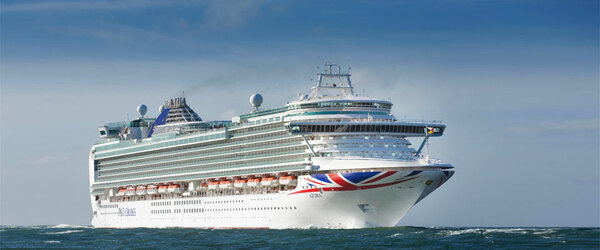
Mediterranean Fly-Cruise
Cruise only — prices from Solo cruise only — from

Ports of Call & Itinerary
14-night voyage departing Valletta.
Printable Itinerary (PDF)Route Map
Mediterranean Fly-Cruise
11 ports plotted · click a marker for details
Day 1
Valletta , Malta
Thursday, 26/08/2027
Malta's capital, the minicity of Valletta, has ornate palaces and museums protected by massive fortifications of honey-color limestone. Houses along the narrow streets have overhanging wooden balconies for people-watching from indoors. Generations ago they gave housebound women a window on the world of the street. The main entrance to town is through the City Gate (where all bus routes end), which leads onto Triq Repubblika (Republic Street), the spine of the grid-pattern city and the main shopping street. Triq Mercante (Merchant Street) parallels Repubblika to the east and is also good for strolling. From these two streets, cross streets descend toward the water; some are stepped. Valletta's compactness makes it ideal to explore on foot. City Gate and the upper part of Valletta are experiencing vast redevelopment that includes a new Parliament Building and open-air performance venue. The complex, completed mid-2013, has numerous pedestrian detours in place along with building noise and dust. Before setting out along Republic Street, stop at the tourist information office on Merchant Street for maps and brochures.
Day 3
Civitavecchia , Italy
Saturday, 28/08/2027
Italy's vibrant capital lives in the present, but no other city on earth evokes its past so powerfully. For over 2,500 years, emperors, popes, artists, and common citizens have left their mark here. Archaeological remains from ancient Rome, art-stuffed churches, and the treasures of Vatican City vie for your attention, but Rome is also a wonderful place to practice the Italian-perfected il dolce far niente, the sweet art of idleness. Your most memorable experiences may include sitting at a caffè in the Campo de' Fiori or strolling in a beguiling piazza.

Day 4
Livorno , Italy
Sunday, 29/08/2027
Livorno is a gritty city with a long and interesting history. In the early Middle Ages it alternately belonged to Pisa and Genoa. In 1421 Florence, seeking access to the sea, bought it. Cosimo I (1519–74) started construction of the harbor in 1571, putting Livorno on the map. After Ferdinando I de' Medici (1549–1609) proclaimed Livorno a free city, it became a haven for people suffering from religious persecution; Roman Catholics from England and Jews and Moors from Spain and Portugal, among others, settled here. The Quattro Mori (Four Moors), also known as the Monument to Ferdinando I, commemorates this. (The statue of Ferdinando I dates from 1595, the bronze Moors by Pietro Tacca from the 1620s.)In the following centuries, and particularly in the 18th, Livorno boomed as a port. In the 19th century the town drew a host of famous Britons passing through on their grand tours. Its prominence continued up to World War II, when it was heavily bombed. Much of the town's architecture, therefore, postdates the war, and it's somewhat difficult to imagine what it might have looked like before. Livorno has recovered from the war, however, as it's become a huge point of departure for container ships, as well as the only spot in Tuscany for cruise ships to dock for the day.Most of Livorno's artistic treasures date from the 17th century and aren't all that interesting unless you dote on obscure baroque artists. Livorno's most famous native artist, Amedeo Modigliani (1884–1920), was of much more recent vintage. Sadly, there's no notable work by him in his hometown.There may not be much in the way of art, but it's still worth strolling around the city. The Mercato Nuovo, which has been around since 1894, sells all sorts of fruits, vegetables, grains, meat, and fish. Outdoor markets nearby are also chock-full of local color. The presence of Camp Darby, an American military base just outside town, accounts for the availability of many American products.If you have time, Livorno is worth a stop for lunch or dinner at the very least.
Day 5
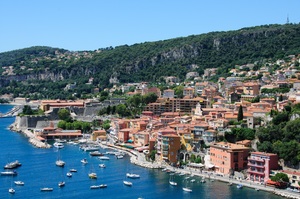
Villefranche-sur-Mer , France
Monday, 30/08/2027
Villefranche-Sur-Mer is located on the Côte d’Azur in Provence – known for its fields of lavender and warm weather – and is highly appreciated for its 14th Century architecture.
Day 6
Ajaccio, Corsica , France
Tuesday, 31/08/2027
Considered Corsica’s primary commercial and cultural hub, the largest city and regional capital of Ajaccio is situated on the west coast of the island, approximately 644 km (400 miles) southeast of Marseille, France. Founded in 1492, vestiges of ancient Corsica in this ville impériale revolve around the city’s most famous son, Napoléon Bonaparte, whose family home—now the national museum Maison Bonaparte—pays tribute to the emperor’s historical influence.Remnants from what was originally a 12th-century Genoese colony are still visible around the Old Town near the imposing citadel and watchtower. Perfect for exploring, the luminous seaside city surrounded by snowcapped mountains and pretty beaches offers numerous sites, eateries, side streets, and a popular harbor, where sailboats and fishing vessels moor in the picturesque Tino Rossi port lined with well-established restaurants and cafés serving fresh local fare.
Day 8
Valletta , Malta
Thursday, 02/09/2027
Malta's capital, the minicity of Valletta, has ornate palaces and museums protected by massive fortifications of honey-color limestone. Houses along the narrow streets have overhanging wooden balconies for people-watching from indoors. Generations ago they gave housebound women a window on the world of the street. The main entrance to town is through the City Gate (where all bus routes end), which leads onto Triq Repubblika (Republic Street), the spine of the grid-pattern city and the main shopping street. Triq Mercante (Merchant Street) parallels Repubblika to the east and is also good for strolling. From these two streets, cross streets descend toward the water; some are stepped. Valletta's compactness makes it ideal to explore on foot. City Gate and the upper part of Valletta are experiencing vast redevelopment that includes a new Parliament Building and open-air performance venue. The complex, completed mid-2013, has numerous pedestrian detours in place along with building noise and dust. Before setting out along Republic Street, stop at the tourist information office on Merchant Street for maps and brochures.
Day 10
Corfu , Greece
Saturday, 04/09/2027
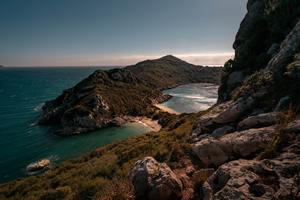
Corfu town today is a vivid tapestry of cultures—a sophisticated weave, where charm, history, and natural beauty blend. Located about midway along the island's east coast, this spectacularly lively capital is the cultural heart of Corfu and has a remarkable historic center that UNESCO designated as a World Heritage Site in 2007. All ships and planes dock or land near Corfu town, which occupies a small peninsula jutting into the Ionian Sea.Whether arriving by ferry from mainland Greece or Italy, from another island, or directly by plane, catch your breath by first relaxing with a coffee or a gelato in Corfu town's shaded Liston Arcade, then stroll the narrow lanes of its pedestrians-only quarter. For an overview of the immediate area, and a quick tour of Mon Repos palace, hop on the little tourist train that runs from May to September. Corfu town has a different feel at night, so book a table at one of its famed tavernas to savor the island's unique cuisine.The best way to get around Corfu town is on foot. The town is small enough so that you can easily walk to every sight. There are local buses, but they do not thread their way into the streets (many now car-free) of the historic center. If you are arriving by ferry or plane, it's best to take a taxi to your hotel. Expect to pay about €10 from the airport or ferry terminal to a hotel in Corfu town. If there are no taxis waiting, you can call for one.
Day 11
Kotor , Montenegro
Sunday, 05/09/2027
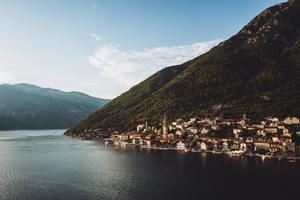
Backed by imposing mountains, tiny Kotor lies hidden from the open sea, tucked into the deepest channel of the Bokor Kotorska (Kotor Bay), which is Europe's most southerly fjord. To many, this town is more charming than its sister UNESCO World Heritage Site, Dubrovnik, retaining more authenticity, but with fewer tourists and spared the war damage and subsequent rebuilding which has given Dubrovnik something of a Disney feel.Kotor's medieval Stari Grad (Old Town) is enclosed within well-preserved defensive walls built between the 9th and 18th centuries and is presided over by a proud hilltop fortress. Within the walls, a labyrinth of winding cobbled streets leads through a series of splendid paved piazzas, rimmed by centuries-old stone buildings. The squares are now haunted by strains from buskers but although many now house trendy cafés and chic boutiques, directions are still given medieval-style by reference to the town’s landmark churches.In the Middle Ages, as Serbia's chief port, Kotor was an important economic and cultural center with its own highly regarded schools of stonemasonry and iconography. From 1391 to 1420 it was an independent city-republic and later, it spent periods under Venetian, Austrian, and French rule, though it was undoubtedly the Venetians who left the strongest impression on the city's architecture. Since the breakup of Yugoslavia, some 70% of the stone buildings in the romantic Old Town have been snapped up by foreigners, mostly Brits and Russians. Porto Montenegro, a new marina designed to accommodate some of the world’s largest super yachts, opened in nearby Tivat in 2011, and along the bay are other charming seaside villages, all with better views of the bay than the vista from Kotor itself where the waterside is congested with cruise ships and yachts. Try sleepy Muo or the settlement of Prčanj in one direction around the bay, or Perast and the Roman mosaics of Risan in the other direction.
Day 12
Split , Croatia
Monday, 06/09/2027
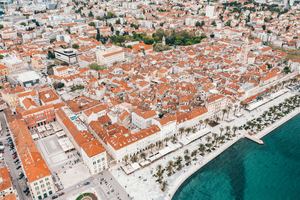
Split's ancient core is so spectacular and unusual that a visit is more than worth your time. The heart of the city lies within the walls of Roman emperor Diocletian's retirement palace, which was built in the 3rd century AD. Diocletian, born in the nearby Roman settlement of Salona in AD 245, achieved a brilliant career as a soldier and became emperor at the age of 40. In 295 he ordered this vast palace to be built in his native Dalmatia, and when it was completed he stepped down from the throne and retired to his beloved homeland. Upon his death, he was laid to rest in an octagonal mausoleum, around which Split's magnificent cathedral was built.In 615, when Salona was sacked by barbarian tribes, those fortunate enough to escape found refuge within the stout palace walls and divided up the vast imperial apartments into more modest living quarters. Thus, the palace developed into an urban center, and by the 11th century the settlement had expanded beyond the ancient walls.Under the rule of Venice (1420–1797), Split—as a gateway to the Balkan interior—became one of the Adriatic's main trading ports, and the city's splendid Renaissance palaces bear witness to the affluence of those times. When the Habsburgs took control during the 19th century, an overland connection to Central Europe was established by the construction of the Split–Zagreb–Vienna railway line.After World War II, the Tito years saw a period of rapid urban expansion: industrialization accelerated and the suburbs extended to accommodate high-rise apartment blocks. Today the historic center of Split is included on UNESCO's list of World Heritage Sites.
Day 13
Dubrovnik , Croatia
Tuesday, 07/09/2027
Nothing can prepare you for your first sight of Dubrovnik. Lying 216 km (135 miles) southeast of Split and commanding a jaw-dropping coastal location, it is one of the world's most beautiful fortified cities. Its massive stone ramparts and fortress towers curve around a tiny harbor, enclosing graduated ridges of sun-bleached orange-tiled roofs, copper domes, and elegant bell towers. Your imagination will run wild picturing what it looked like seven centuries ago when the walls were built, without any suburbs or highways around it, just this magnificent stone city rising out of the sea.In the 7th century AD, residents of the Roman city Epidaurum (now Cavtat) fled the Avars and Slavs of the north and founded a new settlement on a small rocky island, which they named Laus, and later Ragusa. On the mainland hillside opposite the island, the Slav settlement called Dubrovnik grew up. In the 12th century the narrow channel separating the two settlements was filled in (now the main street through the Old Town, called Stradun), and Ragusa and Dubrovnik became one. The city was surrounded by defensive walls during the 13th century, and these were reinforced with towers and bastions in the late 15th century.From 1358 to 1808 the city thrived as a powerful and remarkably sophisticated independent republic, reaching its golden age during the 16th century. In 1667 many of its splendid Gothic and Renaissance buildings were destroyed by an earthquake. The defensive walls survived the disaster, and the city was rebuilt in baroque style.Dubrovnik lost its independence to Napoléon in 1808, and in 1815 passed to Austria-Hungary. During the 20th century, as part of Yugoslavia, the city became a popular tourist destination, and in 1979 it was listed as a UNESCO World Heritage Site. During the war for independence, it came under heavy siege. Thanks to careful restoration, few traces of damage remain; however, there are maps inside the Pile and Ploče Gates illustrating the points around the city where damage was done. It’s only when you experience Dubrovnik yourself that you can understand what a treasure the world nearly lost

Day 15
Valletta , Malta
Thursday, 09/09/2027
Malta's capital, the minicity of Valletta, has ornate palaces and museums protected by massive fortifications of honey-color limestone. Houses along the narrow streets have overhanging wooden balconies for people-watching from indoors. Generations ago they gave housebound women a window on the world of the street. The main entrance to town is through the City Gate (where all bus routes end), which leads onto Triq Repubblika (Republic Street), the spine of the grid-pattern city and the main shopping street. Triq Mercante (Merchant Street) parallels Repubblika to the east and is also good for strolling. From these two streets, cross streets descend toward the water; some are stepped. Valletta's compactness makes it ideal to explore on foot. City Gate and the upper part of Valletta are experiencing vast redevelopment that includes a new Parliament Building and open-air performance venue. The complex, completed mid-2013, has numerous pedestrian detours in place along with building noise and dust. Before setting out along Republic Street, stop at the tourist information office on Merchant Street for maps and brochures.
Room Type & Prices
All prices per person based on double occupancy. Solo traveller prices — single occupancy. Contact our cruise experts for the latest availability and best fares.
Prices include return flights from the UK. Enquire for per-cabin fly-cruise pricing.
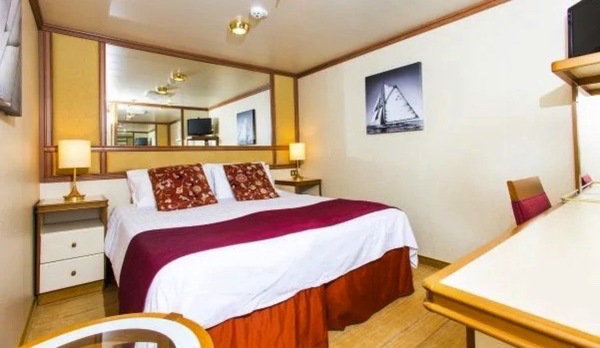
Inside Cabin
159–236 sqft · Up to 4 guests

Sea View Cabin (Obstructed View)
167–261 sqft · Up to 2 guests
Sea View Cabins (Partially Obstructed View)
155–261 sqft · Up to 2 guests
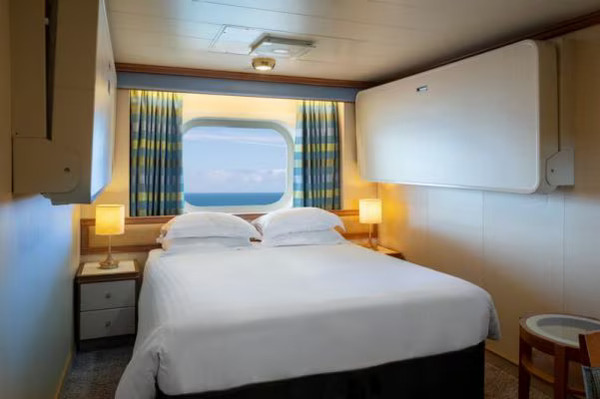
Sea View Standard Cabin
158–166 sqft · Up to 4 guests
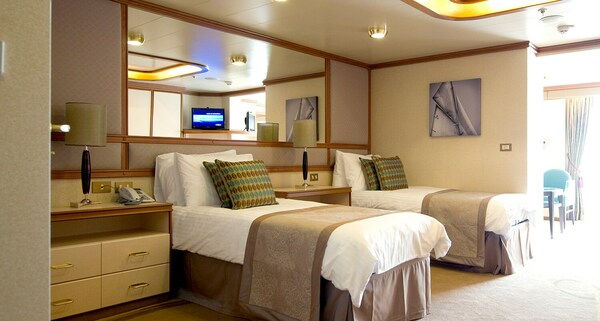
Balcony Standard Cabin
221–421 sqft · Up to 4 guests
Balcony Superior Deluxe
314–466 sqft · Up to 2 guests
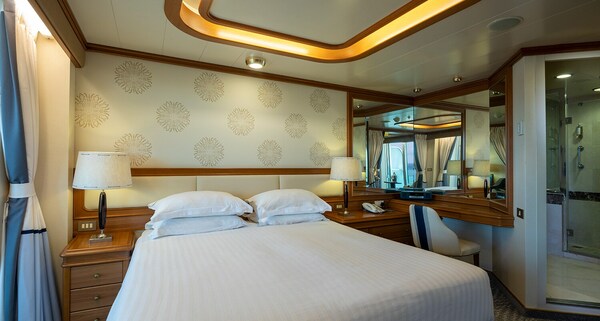
Suite
449–451 sqft · Up to 4 guests
Inside
| Cabin | Grade | Per Person | Avail. | |
|---|---|---|---|---|
| Inside Cabin · 159–236 sqft | PF Inside (PF) | Enquire → | ||
| PE Inside (PE) | Enquire → | |||
| PD Inside (PD) | Enquire → | |||
| PB Inside (PB) | Enquire → | |||
| PA Inside (PA) | Enquire → | |||
| OB Larger Inside | Enquire → |
Inside Cabin · 159–236 sqft
PF Inside (PF)
Inside Cabin · 159–236 sqft
PE Inside (PE)
Inside Cabin · 159–236 sqft
PD Inside (PD)
Inside Cabin · 159–236 sqft
PB Inside (PB)
Inside Cabin · 159–236 sqft
PA Inside (PA)
Inside Cabin · 159–236 sqft
OB Larger Inside
Oceanview
| Cabin | Grade | Per Person | Avail. | |
|---|---|---|---|---|
| Sea View Cabin (Obstructed View) · 167–261 sqft | NF Outside (Obstructed) (NF) | Enquire → | ||
| NC Outside (Obstructed) (NC) | Enquire → | |||
| NB Outside (Obstructed) (NB) | Enquire → | |||
| Sea View Cabins (Partially Obstructed View) · 155–261 sqft | MF Outside (Part Obstructed View) (MF) | Enquire → | ||
| MC Outside (Part Obstructed View) (MC) | Enquire → | |||
| Sea View Standard Cabin · 158–166 sqft | LF Outside | Enquire → |
Sea View Cabin (Obstructed View) · 167–261 sqft
NF Outside (Obstructed) (NF)
Sea View Cabin (Obstructed View) · 167–261 sqft
NC Outside (Obstructed) (NC)
Sea View Cabin (Obstructed View) · 167–261 sqft
NB Outside (Obstructed) (NB)
Sea View Cabins (Partially Obstructed View) · 155–261 sqft
MF Outside (Part Obstructed View) (MF)
Sea View Cabins (Partially Obstructed View) · 155–261 sqft
MC Outside (Part Obstructed View) (MC)
Sea View Standard Cabin · 158–166 sqft
LF Outside
Balcony
| Cabin | Grade | Per Person | Avail. | |
|---|---|---|---|---|
| Balcony Standard Cabin · 221–421 sqft | HF Balcony (HF) | Enquire → | ||
| HE Balcony (HE) | Enquire → | |||
| HD Balcony (HD) | Enquire → | |||
| HC Balcony (HC) | Enquire → | |||
| HB Balcony (HB) | Enquire → | |||
| HA Balcony (HA) | Enquire → | |||
| Balcony Superior Deluxe · 314–466 sqft | DE Superior Deluxe Balcony (DE) | Enquire → | ||
| DD Superior Deluxe Balcony (DD) | Enquire → | |||
| DB Superior Deluxe Balcony (DB) | Enquire → | |||
| DA Superior Deluxe Balcony (DA) | Enquire → |
Balcony Standard Cabin · 221–421 sqft
HF Balcony (HF)
Balcony Standard Cabin · 221–421 sqft
HE Balcony (HE)
Balcony Standard Cabin · 221–421 sqft
HD Balcony (HD)
Balcony Standard Cabin · 221–421 sqft
HC Balcony (HC)
Balcony Standard Cabin · 221–421 sqft
HB Balcony (HB)
Balcony Standard Cabin · 221–421 sqft
HA Balcony (HA)
Balcony Superior Deluxe · 314–466 sqft
DE Superior Deluxe Balcony (DE)
Balcony Superior Deluxe · 314–466 sqft
DD Superior Deluxe Balcony (DD)
Balcony Superior Deluxe · 314–466 sqft
DB Superior Deluxe Balcony (DB)
Balcony Superior Deluxe · 314–466 sqft
DA Superior Deluxe Balcony (DA)
More Departures
Your Ship
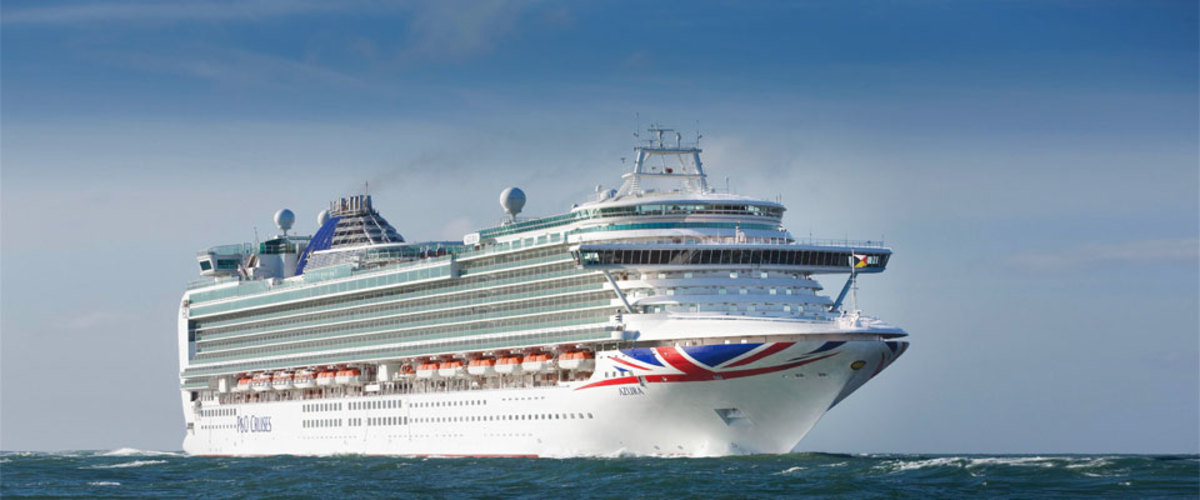
Azura
A social paradise at sea
Whether you seek family fun, romantic moments, or a personal retreat, Azura offers the perfect blend of entertainment and relaxation. Between visiting sun-soaked destinations, why not unwind by the pool, enjoy dazzling shows at The Playhouse, indulge in alfresco treatments at The Retreat, and experience unforgettable dining at venues like The Glass House? With so many venues, there's something for everyone onboard Azura.